
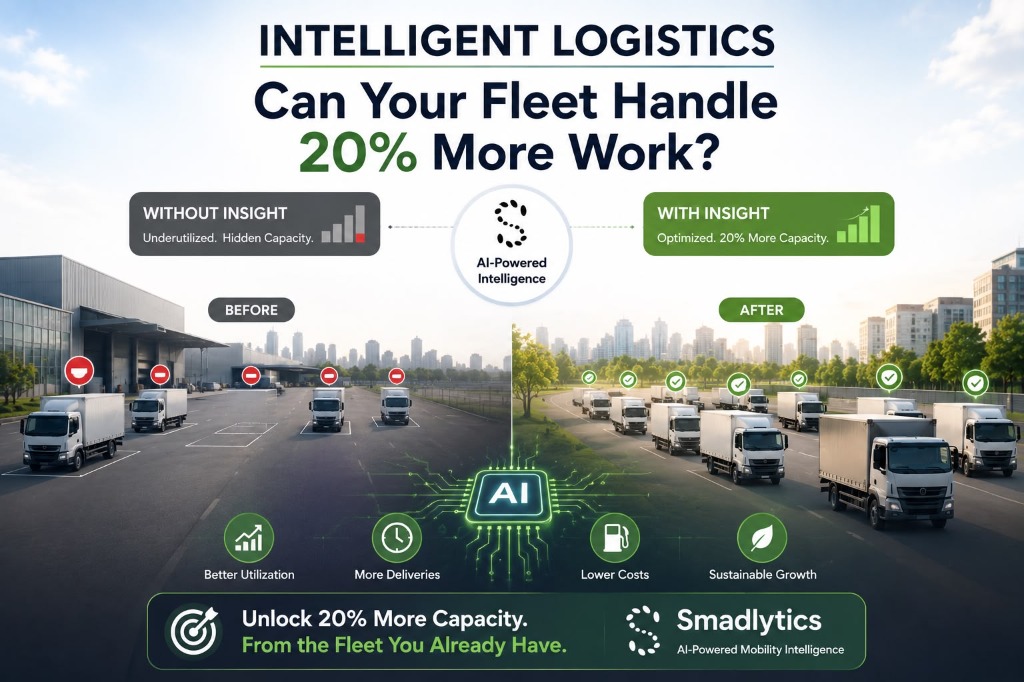
INTELLIGENT LOGISTICS
Before you add more vehicles, find the capacity already hiding inside your fleet.
- A logistics company wins more business.
- Orders increase.
- Customers expect faster delivery.
The first question is usually:
But there is another question that may be even more important:
A fleet can have 100 vehicles and still have significant unused capacity.
Not because the vehicles are sitting unused all day. But because capacity is often lost in small pieces:
Where Capacity Hides & Escapes Daily
- Idle time
- Waiting time
- Inefficient routes
- Empty miles
- Unplanned downtime
- Poor vehicle allocation
- Repeated route deviations
- Underutilized assets
- Excessive driver downtime
- Dispatch inefficiencies
Individually, these may look like minor operational issues.
Across an entire fleet, they can become a significant capacity problem.
This is where Intelligent Logistics changes the conversation.
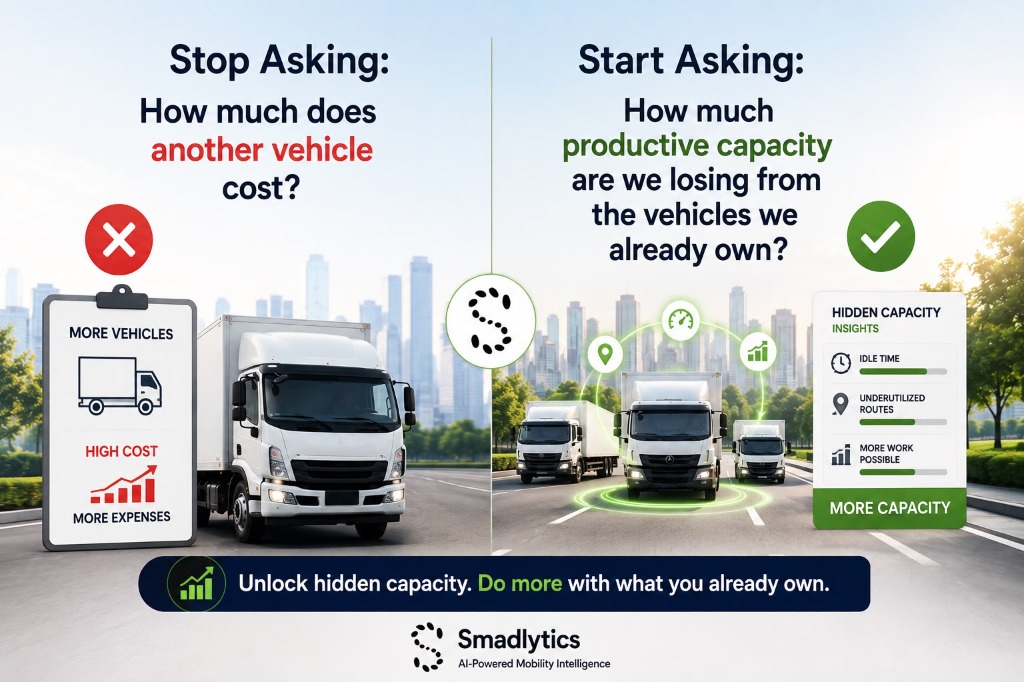
The 20% Question
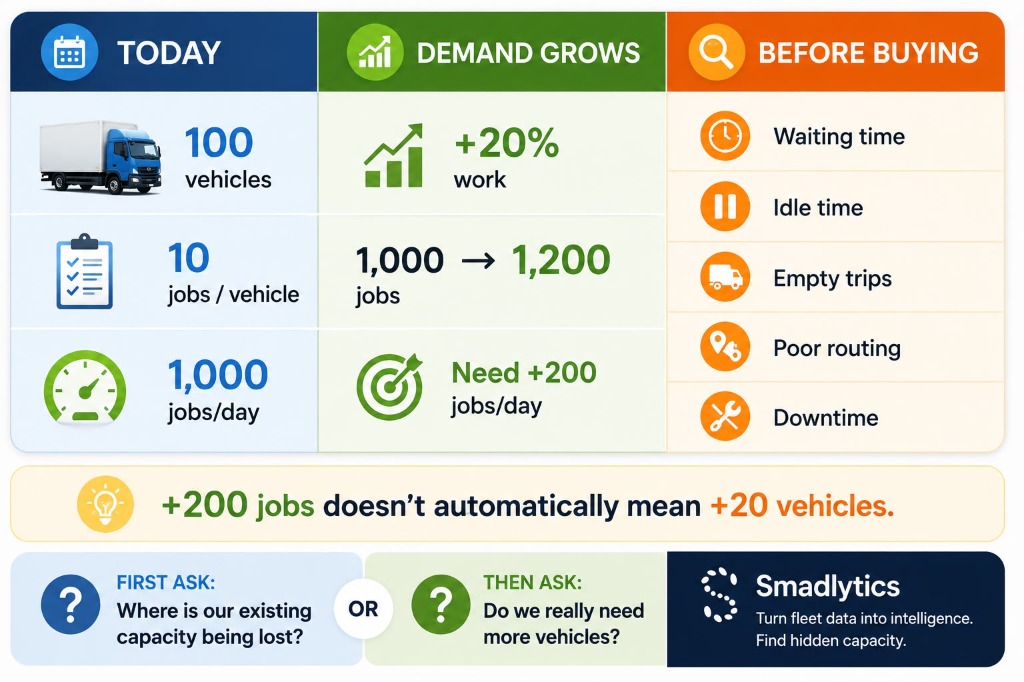
The traditional response may be: Buy more vehicles.
But it may need better visibility into the capacity it already has.
The actual improvement will depend on the fleet, operating model, geography, traffic, delivery density, driver behavior and current efficiency.
The 20% is not a promise….. It is a management question:
What Is Intelligent Logistics?
Intelligent Logistics is the use of AI, IoT, connected vehicle data, analytics and operational intelligence to understand and improve logistics operations.
- GPS tracking answers: WHERE is my vehicle? = Location
- Fleet analytics can answer: WHAT happened? = Patterns
- Intelligent fleet management asks: WHY did it happen? = Root causes
- Predictive intelligence asks: WHAT is likely to happen next? = Early warnings
- Operational intelligence then asks: WHAT should we do about it? = Action Steps
Tracking → Visibility → Analytics → Intelligence → Prediction → Action
The pattern shifts from simply managing vehicles to managing fleet capacity.
Your Fleet May Be Busy. But Is It Productive?
This is one of the biggest distinctions in modern fleet management.
- A vehicle can be: Moving without being: Productive!
- A vehicle can be: Available without being: Well utilized!
- A vehicle can be: Tracked without being: Optimized!
Consider a delivery vehicle that spends:
- ⏱ 45 minutes waiting at a warehouse
- ⏱ 30 minutes in avoidable idle time
- ⏱ 40 minutes taking an inefficient route
- ⏱ 25 minutes waiting at a customer
- ⏱ 35 minutes returning without a productive load
The vehicle is active - The GPS works - The fleet dashboard is updated - But productive capacity is lost.
This is why fleet visibility is not the same as fleet intelligence.
Where Is Your Hidden Fleet Capacity?
The opportunity is rarely one giant inefficiency. It is usually a collection of smaller ones.
Idle Time
Idle time is one of the easiest places to look for lost productivity. But simply saying: “Reduce idling” is not enough. Some idling is unavoidable. A better question is: Where, when and why is excessive idling occurring? AI analytics identifies patterns across vehicles, drivers, locations, times of day, customer sites, and operating conditions to isolate avoidable idle time.
Waiting Time
A vehicle waiting for a loading bay is not necessarily a fleet-management problem. But if 40 vehicles repeatedly wait at the same facility at the same time of day, that becomes an operational pattern. Intelligent logistics identifies recurring warehouse delays, customer waiting patterns, and dispatch bottlenecks to turn delay reports into actionable operational fixes.
Route Inefficiency
The shortest route is not always the most productive route. Traffic, delivery windows, congestion, road restrictions, customer density, parking, and driver behavior all impact route performance. AI-powered logistics intelligence helps identify recurring patterns in how routes actually perform and pinpoints routes consuming unexpected time.
Empty Miles
Delivery → Empty Return → New Pickup. The vehicle is moving, fuel is being consumed, driver hours are ticking away, but productive utilization is low. Fleet analytics identifies patterns in empty movement to explore opportunities for better dispatching, backhaul planning, route restructuring, and load balancing.
Underutilized Vehicles
Consider two vehicles available for 10 hours: Vehicle A completes 14 jobs while Vehicle B completes 9 jobs. Before asking why another vehicle isn't bought, AI asset intelligence investigates why Vehicle B produces significantly less operational output despite similar availability.
Unplanned Downtime
A vehicle that isn't available cannot generate productive work. Unexpected downtime disrupts schedules, dispatching, and customer commitments. Predictive fleet intelligence monitors asset behavior to detect early signals associated with maintenance issues, shifting operations from unexpected breakdowns to predictable availability.
Driver Behavior
Driver behavior affects fuel consumption, vehicle wear, route adherence, and delivery performance. Excessive acceleration, hard braking, speeding, unnecessary idling, and abnormal stops represent operational patterns. The objective shifts from simply scoring drivers to understanding operational patterns.
Dispatch Decisions
Dispatchers make hundreds of daily choices: vehicle, driver, route, order sequence, next job allocation. Even experienced teams cannot manually process every signal across a connected fleet. AI combines location, availability, historical movement, utilization, and delivery constraints to empower dispatchers with decision intelligence.
GPS Tracking vs. Intelligent Fleet Management
This is where the market is changing.
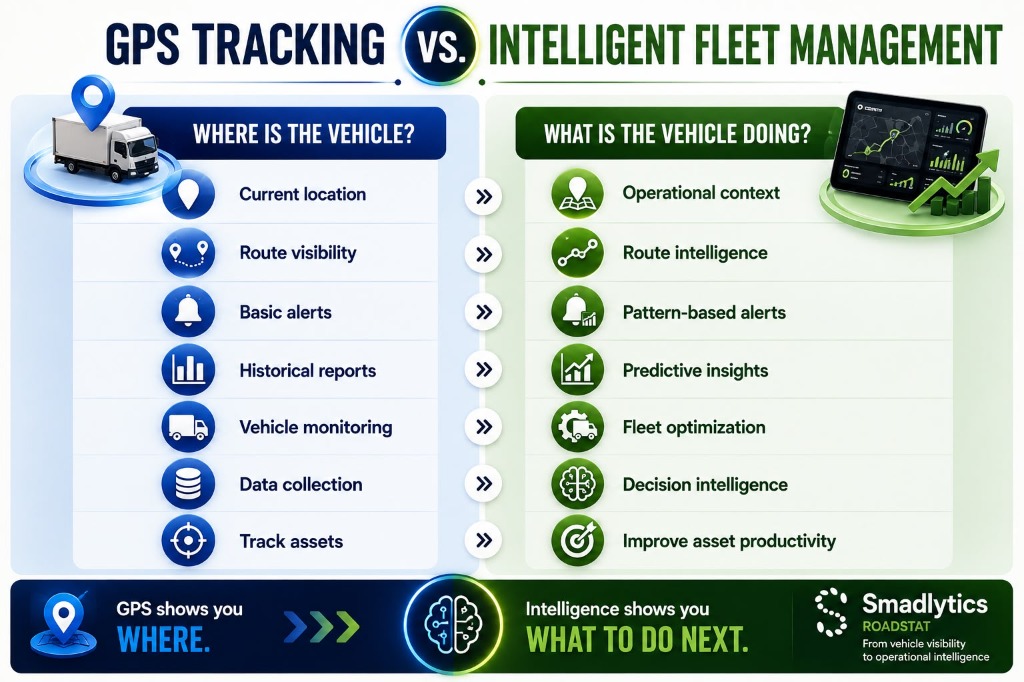
GPS remains valuable. In fact, GPS is an important data source for intelligent logistics. But GPS doesn't have to be the final layer. It can become one signal inside a much larger intelligence system.
Asset Tracking : Where is my asset?
Asset Monitoring : What is happening to my asset?
Asset Intelligence : Is what is happening normal, abnormal, inefficient or risky?
Predictive Asset Intelligence : What could happen next?
Operational Intelligence : What should we do?
That is the journey from: GPS → Data → Intelligence → Action
This is where Smadlytics ROADSTAT creates a difference!
ROADSTAT is not simply another map showing moving vehicles. It is an AI-powered Mobility Intelligence Platform and an AI Asset Intelligence Layer that helps organizations turn connected asset data into actionable operational insights.
That means a logistics company can continue using its existing:
- GPS
- Fleet management software
- IoT devices
- Telematics
- ERP
- Transportation systems
and potentially add an intelligence layer on top.
Smadlytics - A Capacity Multiplier
When you know how much productive work each asset is actually generating and where productive capacity is being lost, you can unlock the business!
Smadlytics is an Intelligence Layer.
A logistics company may already have data coming from:
GPS → IoT → Telematics → Vehicles → Drivers → Routes → Operations
But these systems often operate independently. Smadlytics can bring intelligence across those signals to help answer:
- What is happening across my fleet?
- What is abnormal?
- Where is capacity being lost?
- Which assets are underutilized?
- Which operational patterns keep repeating?
- What should the operations team investigate?
This is the foundation of Fleet Decision Intelligence.
A Simple Capacity Calculation
Let's imagine a fleet with: 50 vehicles
Each vehicle has: 9 productive operating hours per day
That gives: 450 vehicle-hours per day.
Suppose the fleet loses 45 hours through a combination of:
- Waiting
- Avoidable idling
- Route inefficiency
- Unplanned downtime
- Dispatch gaps
10% of available vehicle-hours is lost.
If the organization can recover even part of that lost capacity, it may be able to handle more work without immediately adding the same number of vehicles!
is far more useful than simply asking: “How many vehicles do we need?”
Capacity Before Capital
This can become a new principle for logistics businesses: Find capacity before buying capacity!
Before adding Vehicles, Drivers, Infrastructure, Parking, or Dispatch resources, understand how efficiently the existing fleet is being used. If demand genuinely exceeds physical capacity, fleet expansion may be necessary.
But if significant capacity is being lost through operational inefficiency, adding vehicles can simply add more cost to an inefficient system. More vehicles do not automatically create more productivity.
More assets to manage → More drivers to coordinate → More maintenance → More insurance → More fuel → More operational complexity.
Intelligent logistics asks whether that additional capital is actually necessary.
The Real ROI of Fleet Intelligence
Instead of measuring a fleet intelligence platform by: Number of vehicles tracked → Number of alerts → Dashboard logins → Reports generated
Measure it by business outcomes:
Capacity
Can the fleet handle more work with existing assets?
Utilization
Are vehicles being used productively during available hours?
Availability
How much vehicle time is recovered from unplanned downtime?
Efficiency
How much unnecessary movement and empty mileage is eliminated?
Productivity
How much output and revenue is each asset generating?
Reliability
Are delivery windows becoming more predictable and consistent?
Decision Speed
Can operations teams identify and resolve bottlenecks faster before they impact revenue?
These are the metrics that turn fleet technology into genuine business value.
What If 20% More Work Is Already Possible?
Suppose your fleet could potentially handle 20% more work. But you don't know where that capacity is. You could choose:
- Option 1 — Buy more vehicles.
- Option 2 — Hire more drivers.
- Option 3 — Add more operational staff.
- Option 4 — Improve the productivity of the existing fleet first.
The fourth option doesn't eliminate the need for expansion. It simply helps you make the expansion decision using better information. That is the commercial value of AI-driven Operational Intelligence.
Intelligent Logistics Is Not About More Data
Logistics companies generate enormous amounts of data. The problem isn't always: “We don't have enough data.” It can be: “We don't know what the data is telling us.”
The Data-to-Action Transformation
- Data: Vehicle stopped for 28 minutes.
- Analytics: Vehicle stopped 28 minutes longer than average.
- Intelligence: This location creates repeated delays for multiple vehicles.
- Prediction: The same delay pattern is likely during this operating window.
- Action: Adjust dispatch timing or vehicle allocation.
That is the journey from Reactive Logistics to Predictive Logistics: Data → Insight → Prediction → Action.
Traditional logistics often operates reactively:
- A vehicle breaks down → React.
- A driver is delayed → React.
- A customer complains → React.
- A delivery is late → React.
- A vehicle leaves its route → React.
Intelligent logistics aims to make operations proactive:
Detect (Identify unusual behavior) → Understand (Determine what changed) → Predict (Assess what could happen next) → Act (Give operations team a reason to intervene).
The Fleet of the Future Will Be More Intelligent, Not Just Larger
The next competitive advantage in logistics may not come from owning the largest fleet. It may come from operating the most intelligent fleet.
A smaller fleet with:
- Better utilization
- Better routing
- Better dispatch
- Better asset availability
- Better driver intelligence
- Better predictive maintenance
- Better operational visibility
could potentially outperform a larger fleet that operates inefficiently.
The objective is not to eliminate physical assets — it is to maximize the productive value of every asset.
What Would 20% More Capacity Look Like?
It doesn't necessarily mean: 20% more vehicles. It could mean:
- 20% more productive vehicle-hours.
- 20% fewer wasted hours.
- 20% better utilization.
- 20% more completed jobs from the same fleet.
- 20% more capacity before the next fleet expansion.
The actual number depends on the operation. That is why Smadlytics says: “Let's find out where your hidden capacity is.”
Smadlytics helps logistics companies turn connected fleet data into intelligence that can uncover operational inefficiencies, improve asset utilization and help unlock more productive capacity from existing fleets.
Not just another dashboard!!
Not simply another technology expense!!!
An intelligence layer for your existing fleet.
Frequently Asked Questions
Conclusion
The next time your fleet receives 20% more orders, don't immediately ask: “How many more vehicles do we need?”
Ask: “How much more work can our existing fleet handle?”
Then ask: “Where are we losing capacity today?”
The answer may be hiding in:
Idle time · Waiting time · Empty miles · Inefficient routes · Underutilized vehicles · Downtime · Driver behavior · Dispatch decisions · Poor asset allocation
The fleet may already have more capacity than you think. You just may not have the intelligence to see it.
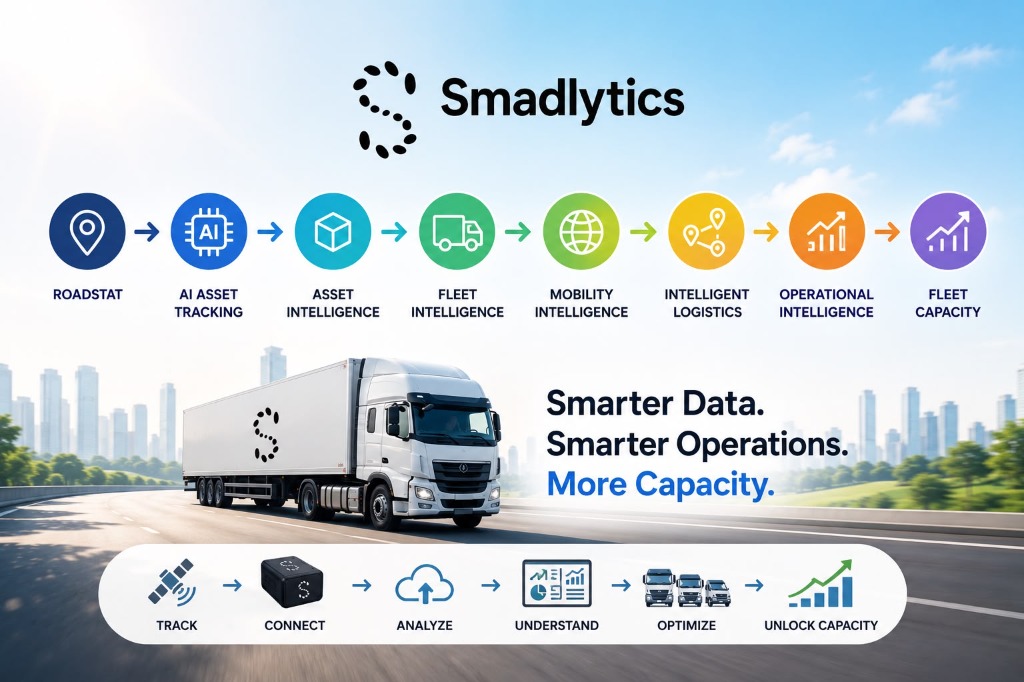
Smadlytics ROADSTAT - AI-Powered Mobility Intelligence for Intelligent Logistics
From GPS Tracking → Asset Intelligence → Fleet Intelligence → Operational Intelligence
From tracking vehicles to unlocking capacity.